


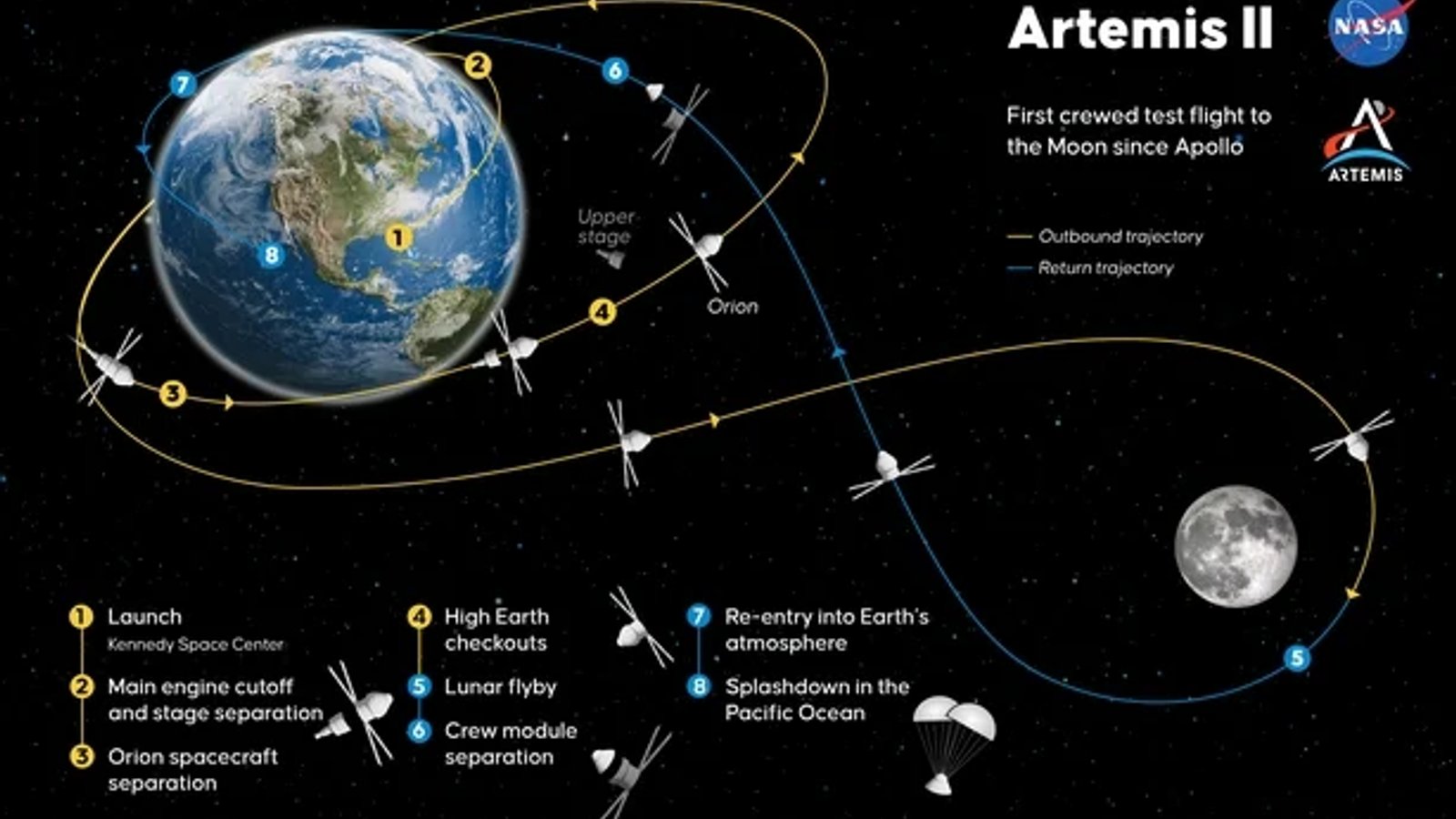

As Artemis II arcs toward the Moon this week, it’s easy to get swept up in the romance.
Four brilliant astronauts—Reid Wiseman, Victor Glover, Christina Koch, and Jeremy Hansen—are living the dream we’ve all watched in movies: the first humans to leave low-Earth orbit in more than half a century. The photos streaming back are breathtaking—Earth shrinking to a blue marble, the far side of the Moon sliding into view like a secret finally revealed.
I love those images too. I’ve spent decades in a variety of roles, including as a test director signing off on crewed launches and rehearsals, and I still feel that thrill in my chest. The journey is worth celebrating.
But right now, while the world cheers the fly-by, my mind is already on splashdown. That’s the part the cameras don’t linger on- the moment Orion slams back into Earth’s atmosphere at 25,000 miles per hour, its heat shield glowing white-hot, with parachutes popping open over the Pacific like a final prayer answered.
Those of us who have had the honor and responsibility of launching people into outer space and getting them home alive, know the real work never stops at liftoff. It lives in the quiet, relentless focus on every single minute of the return.
Excitement is fuel, but vigilance is the seat belt.
The Whispers of History
History whispers why we can never look away. In 1970, Apollo 13’s oxygen tank exploded 200,000 miles from home. The crew survived because the ground team refused to treat a single failing system as “good enough.” They improvised a CO₂ scrubber from duct tape and socks while the world held its breath. Fast-forward to 1986: Challenger lifted off in cold weather, and an O-ring issue that should have been resolved long before it failed in 73 seconds. Fourteen years later, Columbia disintegrated on reentry because a briefcase-sized piece of foam had struck the wing during launch—damage noted but not fully pursued. One second of relaxed attention, one assumption that “it’ll probably be fine,” and lives changed forever.
Lessons Learned…Lessons Applied
Those tragedies forged hard lessons that now quietly strengthen Artemis II, giving this flight a real edge in safety. From Challenger, we learned the deadly cost of pressure on engineering judgment and the need for true redundancy in critical systems. Today, solid rocket booster joints on the Space Launch System incorporate redesigned seals with added layers of protection—redundancies born directly from the O-ring failure that doomed Challenger. No longer do we accept “probably fine” when cold temperatures or material stress could compromise a seal.
Columbia taught us that launch damage cannot be dismissed as routine. Foam strikes were once normalized; now, rigorous imagery analysis, independent reviews, and a culture that demands engineers speak up without fear of being overruled have become standard. For Orion’s return, this translates into redesigned crew seats/restraints and enhanced helmet head/neck support—directly addressing the crew survivability vulnerabilities exposed in 2003.
NASA’s “Successful Failure”
Apollo 13 hammered home the power of robust contingency planning and creative problem-solving under pressure. Its “successful failure” showed that when one system fails, backups and improvisation save lives. Artemis II benefits from vastly improved life support redundancy, extended battery capacity, and detailed abort scenarios—rehearsed far beyond what Apollo crews had. Even the spacecraft atmosphere is safer—no pure oxygen on the pad, echoing the earlier Apollo 1 fire that underscored material and hatch design flaws. These aren’t theoretical upgrades; they’re battle-tested changes embedded in every checklist I once reviewed and every simulation run today.
Enter…The Guardians
So while Artemis II’s lunar photos are lighting up social media, the teams of yesterday once led—and the ones flying the console today—are scanning every telemetry feed, every redundant system, every possible “what if.”
They’re not romantics in this moment; they are Guardians.
Their job is to treat the splashdown checklist with the same intensity as the launch countdown. Because in space, the margin between triumph and tragedy is measured in seconds and degrees.
That same discipline is the tremendous lesson this mission offers every one of us in our ordinary lives.
Not So Fast…
Yet even with these hard-won improvements giving us stronger confidence than ever before, we are not off the hook yet. This flight still carries real risks we deliberately accepted to fly as is.
The Orion heat shield, for example, suffered unexpected charring, spalling, and material loss during Artemis I’s uncrewed reentry; NASA adjusted the trajectory to ease thermal stress but admits the root cause isn’t fully replicated in tests. Critics, including veteran engineers and astronauts, warn that cracks could still propagate under crewed loads. This dissenting debate should not be dismissed lightly.
Likewise, the full environmental control and life support system is operating in its complete crewed configuration for the first time on a deep-space mission—untested at this scale with humans breathing the air and relying on its redundancies far from home.
We fly with eyes wide open because the data says the crew returns safely, but pretending those accepted risks have vanished would betray every lesson we’ve learned.
Think about it. How often do we chase the exciting launch—the new job, the big move, the Instagram-worthy vacation—and then coast once the thrill kicks in? We post the mountaintop selfie and forget the descent is where most accidents happen. I’ve seen it in my own career and in the lives of friends and colleagues. A project at our work rockets through the kickoff meeting, but the real test comes in the quiet weeks of execution: the follow-up emails you’re tempted to skip, the safety check you assume someone else will handle, the “it’s probably fine” that echoes the ignored O-ring or the overlooked foam strike.
Looking in the Mirror
In our personal lives, the pattern is identical. You buckle the kids into the car for a road trip, hearts full of adventure, but the real vigilance starts on the long highway miles when fatigue sets in and the phone pings. Or you launch a marriage, a business, a fitness goal with fireworks and motivation—and then drift when the daily grind arrives.
Apollo 13 didn’t fail because the launch was bad; it survived because the team never stopped sweating the small stuff on the way home.
Challenger and Columbia remind us that even flawless takeoffs can end in heartbreak if we stop paying attention at the precise moment the stakes feel routine.
The Real Story of Artemis II
So here’s the gift Artemis II is handing us while the crew is still out there: a master class in sustained vigilance. Success isn’t the rocket clearing the tower or the perfect Moon photo. Success is the parachute opening exactly as designed, the capsule bobbing safely in the ocean, the crew stepping onto the recovery ship with smiles and stories. That only happens when every single person—from the astronauts travelling at 25,000mph in outer space to the engineer back on Earth monitoring battery voltage right now—refuses to let excitement blind them to detail.
In your own life, the next time you feel the rush of a new beginning, pause and ask: Am I still watching every minute of the return? Am I treating the “boring” details with the same respect I gave the glamorous launch? The astronauts will come home because someone refused to look away. You can bring your own missions home the same way—by choosing vigilance over romance when it matters most.
That’s the real story of Artemis II. Not just four people flying around the Moon, but thousands on the ground who understand that getting them back is the part worth losing sleep over.
And if we all adopt that mindset—in boardrooms, living rooms, and everywhere in between—our everyday missions will have far fewer sleepless nights of their own.
____________________________________________________________________________________
Mike Ciannilli | Aerospace Technical Advisor | Media Consultant | Former NASA Test Director |
Mike Ciannilli is an aerospace engineer and former NASA test director and mission leader who explains how disciplined decisions prevent failure in complex space missions. Drawing on experience in mission operations and test director environments, he analyzes developments in human spaceflight, mission risk, and major program decisions.
Preventing failure in complex space missions through disciplined decisions and lessons applied. https://preventfailure.com